I know it’s short notice, but I just found out about it the other day … the UK Tarot Conference in London will be held on the 14th and 15th of October. I wish I could go!
Friday afternoon will kick things off with Trudy Ashplant revealing the insights of the Court Cards. Sasha Fenton will follow up with her presentation, Tarot and Astrology: A Forgotten Link Rediscovered.
Saturday will be a full day of seminars, starting with Gaynor Thompson. She’ll be looking at how to get beyond the literal meaning in the cards by connecting to your sixth sense.
Mark Ryan and John Matthews, creators of The Wildwood Tarot will be there as well, teaching a workshop about their deck and delving into some fascinating spreads designed just for it.
Finally, the conference will close with celebrated author Anna Franklin as she explores the journey of initiation as it unfolds within the Tarot.
Sounds like a wonderful way to spend a weekend in London. If you’re interested, sign up soon. Tickets are going fast.
In it he argues that Yeats’ interest in the occult grew naturally from an Irish culture rich in fairy-lore, folktales and the supernatural.
And from Foster’s telling, the fairies in this tradition have little in common with Disney’s Tinkerbell. They’re pretty hardcore, downright scary even.
Published in 2008 as the first in a series on sacred foods of the Americas, the book describes the role of chocolate in Mesoamerican religion, politics, economics, and healing through the last 3000 years.
Coveted by gods and humans alike, chocolate has played an integral part in fertility, harvest, marriage, death and rebirth rituals.
And not just by the ancients. Women in modern day Oaxaca still practice the secret methods of cocoa processing.
Certainly contemporary societies’ demand for chocolate in all forms is insatiable. And we too use it to celebrate love at Valentines, and rebirth at Easter.
Delicious, magical, and at least in its dark form, good for our health – chocolate has it all!
So try seeing your next chocolate craving as a message from the divine. Sometimes indulgence is what the gods are asking of us.
If you’re an occult book fan and happen to be in Seattle this coming weekend, check out the third annual Esoteric Book Conference, one of the biggest gatherings of its kind in the US.
Founded by William Kiesel, publishing director of Ouroboros Press, it’s the place to find books on every kind of esoteric wisdom, including of course, alchemy, magic, and astrology.
According to Kiesel, the conference focuses more on the books themselves than the belief systems they espouse. But a quick look at the presentations, art show, and performances suggests it’s a more magical event than he might be admitting.
Presenters include authors of books like Making The Mundane Magical: Aleister Crowley’s Magus Initiation and the Practice of Esoteric Hermeneutics and The Ladies of the Lodge: Women of Today’s Golden Dawn Speak on the Practice of Magick. I bet they’ll be talking about more than just bookbinding.
The seminars look fascinating, but if you only want to spend your afternoon browsing through all the incredible books, the book fair is free, and open to the public.
As described in Science Daily, the research concludes ‘that humans are predisposed to believe in gods and an afterlife, and that both theology and atheism are reasoned responses to what is a basic impulse of the human mind.”
The three-year international research project was led by psychologist Dr. Justin Barrett from the Centre for Anthropology and Mind at Oxford University.
It involved 57 researchers conducting over 40 studies, in 20 countries, representing a diverse range of cultures.
They weren’t trying to prove or disprove the existence of god, the afterlife or anything supernatural. They were simply looking at whether such concepts are taught or innate to our make-up.
Put another way, is it nature or nurture that makes us believe in magic and religion?
Findings from the research will be published in two books by Barrett – Cognitive Science, Religion and Theology, and Born Believers: The Science of Childhood Religion.
Project Co-Director Professor Roger Trigg has also written a book called Equality, Freedom and Religion, where he applies the research to questions surrounding morality and the freedom of religion.
I look forward to all three books, and any others that might come out of this work.
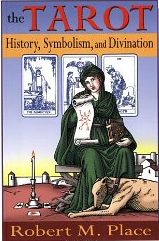
It’s been out since 2005, but I finally read it last week and it’s amazing. I might even say it’s the best Tarot history book I’ve read to date.
To understand the origins of the Tarot, it’s important to understand the European culture from which it grew. Renaissance art, alchemy, hermeticism, neoplatonism – it’s all part of the story, and Place tells it very well.
He takes us card by card through the Major Arcana of the Tarot of Marseilles, explaining the symbols and why they may have been chosen.
As the ‘blueprint’ to all occult decks to follow, understanding the symbols in the Marseilles is vital to understanding how the ideas in the later decks developed.
Ultimately, Place’s focus is on the Waite-Smith Tarot, designed by Arthur E. Waite and painted by Pamela Colman Smith.
He looks at all 78 cards in the deck, and as an added bonus, offers some tips on how to use them. There are exercises, spreads and a summary of the six patterns found most often in readings. All very useful.
It’s a fantastic book for new readers, and old, and anyone who’s interested in Renaissance art, history or philosophy. It left me wanting to learn more.
It was first published back in 2000, but it’s well worth reading now.
McMoneagle learnt Remote Viewing in the U.S. Army as part of the Stargate Project. In fact, he was Remote Viewer #001 and was awarded the Legion of Merit for ‘producing crucial and vital intelligence unavailable from any other source.’
As the title suggests, this book is about Remote Viewing, or the ability to gather information about an inaccessible target through psychic means, regardless of distance, shielding, or time.
According to McMoneagle, what distinguishes Remote Viewing from other psychic work is the protocol followed by the viewers involved.
Methodologies vary widely, and could include Tarot reading or spirit guides. But if the strict scientific procedures described in the book aren’t followed, what’s happening isn’t officially called Remote Viewing.
The book doesn’t teach how to be a Remote Viewer so much as how to prepare yourself and your psychic session to be as scientifically pure as possible.
It also covers questions surrounding who might make a particularly good viewer, and what states of mind are most conducive to positive outcomes.
Also examined are what makes a good target, the ethics of Remote Viewing, and recommendations for training and record keeping.
It’s an intelligent, no nonsense discussion of a topic that’s often hard to pin down. If you’re looking to get past some of the woo-woo in the psychic field, this might be a book for you.
Take a look at this video of Mitch Horowitz talking about the emergence of liberalism, occultism and the feminist movement in the United States. It’s part of the Big Think series.
In it, he argues that it’s no surprise these movements grew together, as all three were rooted in radical ideologies of democracy, equality and personal empowerment.
The book chronicles the history of spiritualism and the occult in the US starting in the 1770s, and focusing on the Burned-over District in Upstate New York.
This video is a quick overview of some of the main themes in the book.
Take a look, and if you get chance, read the book. It’s fascinating.
From the beauty of the Hudson Valley, to the brilliance of the company and the magic of the cards, this is going to be an amazing retreat. Get there if you can.