This time-lapse video shows the birth of a baby oak tree from a tiny little acorn.
It was shot by British filmmaker Neil Bromhall over an eight month period.
While I was watching it, I couldn’t help but think of the Aces in the Tarot. I often describe them as seeds, and here’s a seed, growing right in front of us.
Ace of Wands
I know this acorn is actually growing into the earth, so the Ace of Pentacles would be an obvious comparison. But I think of the Ace of Wands when I watch the film.
It’s the push up from the earth that impresses on me, the little tree’s stretch for the sky. It’s reaching towards the Sun, the home of all fire.
Whatever Ace you might think of, this acorn helps remind us that all great ventures start from the very tiniest of beginnings.
A new study led by psychologist Davide Rigoni of Italy’s University of Padova, suggests that just thinking that we have no free will causes us to to behave as if we don’t.
The study wasn’t trying to determine whether or not there is free will, a question still up for debate. It just looked at how the human brain reacts when we think we don’t have it.
Half the group read a passage that described free will as illusory. While the other half read a passage that didn’t mention free will at all.
testing the brain
Test subjects then sat in front of a computer screen and were attached to an EEG machine. They were asked to press a button whenever and however many times they chose, while indicating the time they became aware of their intention to act.
The researchers were examining the subjects’ ‘readiness potential’, or the brain activity that occurs in the moment we first think to do something, then send signals to our muscles to actually do it.
It’s that moment of ‘intention’ that researchers were particularly interested in. They thought that the strength or weakness of the brain activity right then, might reflect one’s belief or disbelief in free will.
As it turned out, the people who had read the passage rejecting free will displayed significantly lower readiness potentials. They appeared to have less voluntary control than the other group.
The study seemed to show that losing faith in free will impairs our brains’ readiness to act, even before we’re aware of the intention to move.
Other studies have shown that when people stop believing that they have free will, they’re more likely to cheat, less likely to be helpful and generally less motivated.
It’s an interesting and important issue for Tarot readers. Especially ones who use the cards to predict.
If these findings are correct, they point to why it’s so important that readers not give their clients the feeling that they have no control over their own future.
It’s true that many life events are outside of our control. But a reading should empower people to find a path through these uncontrollable situations. Not leave them cowering in fear, or dreaming of a miracle life raft that’s just around the corner.
#1 The Magician
Thinking about this subject of course brings me to the cards themselves. How does Tarot address the issue?
The first card that comes to mind when I hear the phrase ‘free will’ is the Magician. Sure the Fool is extraordinarily free, but he’s not trying to ‘will’ anything.
That’s the Magician’s domain. He’s interested in how to initiate action and manifest what he intends. For him, everything is in its ideal form. All is possible. And he’s in charge of the whole production.
It’s the Magician’s self-directed will that really starts the whole Tarot story. He and his will represent the initial driving force to life, our intention to manifest something, whatever it might be.
#15 The Devil
On the other end of the spectrum is the Devil, representing absolute lack of free will.
Other characters in the deck might want to exert power over others, ie. the Emperor and the Hierophant. Even Justice can be pushy at times.
But the Devil really likes control, going so far as to chain his victims to his pedestal.
When this card comes up in a reading, people are often facing some sort of compulsion, addiction or obsession. Lack of control, or the desire to control others is at issue.
The Devil can make people feel like there’s no point in even struggling. And he’s so convincing that he has no need to tighten his prisoners’ restraints.
They can clearly leave if they want to. The chains are loose. But as the study described above suggests, if you don’t believe you’re free, you’re unlikely to act like you are.
Free will, and the lack there of, seem to be coexistent states. Or at least that’s how it feels in my life.
I know I can’t control most of what’s going on around me. But in my mind, I like to believe I’m my own Magician, and my own Devil. It’s up to me who I let rule inside.
______________________________________________________
‘Fate and Free-will’ is the topic at this year’s Omega Tarot Conference. If you’re interested in hearing what some great Tarot minds have to say about it and can get to Rhinebeck, NY at the end of July, check it out.
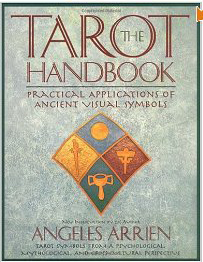
The first book I ever read about Tarot was the original version of The Tarot Handbook, by Angeles Arrien. At the time, I had just got a copy of the Thoth deck, also my first, and was rummaging around in a discount book store.
Arrien’s book was there, with images of my new cards pictured on the cover, on sale for only $10. Of course I bought it on the spot, and started figuring out Tarot Soul and Growth cards right away.
Her system helped me a lot. And at the time, it was one of the few books available on the Thoth deck. The one I got next was Crowley’s own Book of Thoth, which could have been a little intense had it been my first.
The reason I bring this up is that Angeles Arrien will be teaching a weekend seminar on symbolism and the Tarot, July 16 and 17, at the California Institute of Integral Studies in San Francisco. I can’t be there, but I wish I could.
She’ll be exploring the meaning and significance of how symbols in the Tarot function as internal and external mirrors for our own various levels of consciousness.
Arrien is a cultural anthropologist, with expertise in psychology and comparative religions, and of course Tarot. She really knows her stuff. It’s going to be a mind opening weekend.
People at all levels of Tarot experience are encouraged to participate. And Tarot reader or not, it’ll be of especial interest to those in the counseling, coaching, teaching, management, and service professions.
This video has nothing to do with Tarot, but it does show us that what we see isn’t always what we’re looking at.
The clip is called ‘Silencing Awareness of Change by Background Motion’ and recently won the 2011 Best Illusion of the Year from the Neural Correlate Society.
It was created by Jordan Suchow and George Alvarez from Harvard.
When the coloured dots start spinning, it might seem like they’ve stopped changing colour. But that’s not the case. It’s just what our brain is telling us.
Concentrate on the white dot in the center, and see what you see.
As stated in the masthead, it’s meant to “provide a platform for the dissemination of new research and ideas pertaining to anthropological approaches to the study of paranormal beliefs, associated practices and phenomena.”
Though the focus is anthropological, they branch into psychology, parapsychology, sociology, folklore and history.
Articles include titles like ‘The Therapeutic, Ethical and Relational Dynamics of Mediumship and Psychic Consultations‘, ‘Ethnographic Encounters with the Paranormal,’ and ‘Clairvoyance, Class & Convention‘. The theme of April’s issue is ‘PSI & the Psychedelic Experience.’
It’s great. And despite some occasionally wordy titles, very readable.
Scott Jones is a writer and filmmaker, currently working with Kripal on a film adaptation of Authors of the Impossible. They discuss their film in the first podcast.
I’ve listened to three of the five so far, and am looking forward to the rest. All have been fascinating.
If you’re interested in that place where science and the mystic meet, you’ll really enjoy these talks. I hope they record more.
______________________________________________________________________________
Here’s a short clip from the film. It’s part of an interview with comic book writer Doug Moench where he describes an extremely frightening synchronistic event from his own life.
As the man who coined the terms collective unconscious and synchronicity,Carl Gustav Jung has been a mega-influence not only in the fields of psychology and human consciousness, but also in the in the world of tarot readers, psychics and mystics alike.
His ideas, though not directed at Tarot, have certainly shaped how many readers see the cards.
Tarot readers often describe the images from the deck in terms of archetypes, a concept thoroughly examined and expounded upon by Jung.
And the whole process of tarot reading itself might be described as ‘intended synchronicity’. We’re actively creating a meaningful, acausal event meant to access information from the unconscious.
Though Jung doesn’t mention Tarot at all in the clip below, it’s well worth watching anyway.
It’s from a BBC interview in 1959. In it Jung talks about fear, time, space, death and why it’s so important for us to know ourselves as best we can.
It’s part 4 of 4 and starts mid-conversation. If you’d like to see the others parts, links are posted below.
Simplistically speaking, Augmented Reality can be described as a realtime, interactive environment that combines the real world with the virtual.
Helen Papagiannis, a PhD candidate in Communication and Culture at York University in Toronto, designed an Augmented Reality exhibit for the Ontario Science Centre. Among other things, it involves old movies, a fog machine and my favourite part, playing cards.
Someone enters an area where there’s a platform with some cards on it. When the person places a card in the center of the platform, fog starts billowing and an image on the wall identifies the card they chose. A film by Augmented Reality pioneer, Morton Heilig then begins.
Of course for me, it would be even more fun if the cards were Tarot cards and the film that appeared was about the theme in that card, but that’s a project for another time. I think this one is great as is.
But in the video below where Papagiannis talks about her project, what I especially like is what she has to say about wonderment. Something I’ve always felt about the Tarot.
She describes wonderment as being part delight, curiosity, inquiry and action. Interestingly enough, in her presentation, she highlights these ideas in blue, pink, yellow and green.
I couldn’t help but see her descriptors as the four suits – cups for delight, wands for curiosity, swords for inquiry and the disks for action.
And when Papagiannis talks about both cinema and Augmented Reality, she describes the technology itself as being at least as entrancing as the story it tells. I’d say exactly the same thing about Tarot.
The more I think about it, Augmented Reality and the Tarot are not so dissimilar. Not only is Tarot a technology of wonderment, a tool to inspire delight, curiosity, inquiry and action. But it also plays between the worlds.
As Augmented Reality manouevers between the real and the virtual, the Tarot bridges the conscious and the unconscious, and at it’s best, the body and the soul.
Papagiannis has some advice to AR designers, technicians and scientists. She encourages them to “be responsive, and actively seek and inspire wonderment to see the world afresh.”
There couldn’t be better advice to Tarot readers everywhere. So I say ‘ditto that’.
Tomorrow is the Winter Solstice. And it’s even more special this year than usual. Not only will it be the shortest day and longest night of 2010, but it falls on the same day as a full lunar eclipse. This hasn’t happened in 456 years!
The sun, earth and moon will begin to align at 1:33 a.m. EST causing the earth’s shadow to appear as a dark red bite at the edge of the moon. The ‘total’ eclipse will start at 2:41 a.m. and last 72 minutes.
According to NASA, the peak of the event will be at 3:17 a.m. “when the moon will be in deepest shadow, displaying the most fantastic shades of coppery red.”
Astrologically it’s kind of a big deal too. Eclipses speed things up. And often uncover what’s hidden. They highlight situations in our lives that require attention.
What comes up during an eclipse isn’t always easy to face, but it’s always worthwhile to consider. Let’s make the most of this one.
I’ve written about Cornell psychology professor emeritus Daryl Bem and his precognition experiments before. A former stage magician, mentalist and self-described sceptic, Bem has been researching human predictive capacity for two decades now.
His scientific paper, Feeling the Future, will be published in next month’s issue of The Journal of Personality and Social Psychology. His focus has been on the human potential to anticipate future experiences. Are we able to know things that are going to happen before they do?
His research involved nine experiments and more than 1,000 university students. According to Bem, in all but one of the experiments, the hypotheses that psi exists is confirmed. He says, “the odds against the possibility that the combined results are merely chance coincidences or statistical flukes are about 74 billion to 1.”
Of course the next step is critical discussion of his work and replication. Bem acknowledges that most academic psychologists don’t believe psi exists. In fact, he claims they’re more skeptical than physicists. But he’s ready for their imput.
His intention has been to provide well-controlled demonstrations of psi, able to be replicated by independent investigators. To that end, Bem has been compiling replication packages for scientists interested in running the tests themselves. As he says, “that is the acid test of any surprising new finding: independent replication.”