He was buried over four hundred years ago, exhumed about a hundred years ago, and now they’ve dug him up again. Tycho Brahe was a Danish nobleman, astronomer, astrologer and alchemist who died mysteriously in 1601.
Born in 1546, Brahe is considered the founder of modern observational astronomy. And he came up with his own model of the universe, the Tychonic system. He thought that all the planets but the earth revolved around the sun, and that the sun and moon revolved around the earth. Of course he was wrong.
But he was correct about a lot of other things. No one before Tycho had ever tried to study the stars and planets as comprehensively as he did. Prior to him, it was commonly believed that beyond the moon, the universe was steady and unchangeable. His meticulous observations challenged that view and there was no going back.
Details surrounding his sudden death in Prague have remained elusive. Bladder infection, kidney failure, maybe murder. Perhaps poisoning from his prosthetic nose. We don’t know. But Danish scientists from Aarhus University are determined to find out.
They have to return the bodies of Tycho and his wife to Prague today, but the researchers have been feverishly sampling tissue and bone, and promise to share their discoveries in a book due out next year.
antimatter
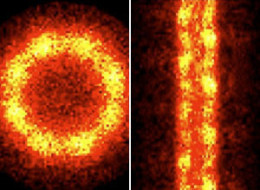
What beautiful synchronicity that the man who coined the term nova and changed our view of the universe forever, resurfaced the week CERN scientists captured antimatter and another team of researchers found a Jupiter-like planet on the outskirts of the Milky Way.
Tycho was above ground for a moment in 1901 as well. Just as the Curies were playing with radium and polonium, and Marconi received his first radio signal from across the Atlantic. Nothing’s been the same since.
What’s that antimatter going to tell us? And the new planet? What huge discoveries are we about to make? Are our perceptions of everything, including our place in the world, about to change?
Exciting times. No wonder Tycho wanted to join us for a bit. Or maybe he’s some sort of herald.
Watch this brilliant video. You’ll go from a picnic scene in Chicago to the far reaches of the universe, back on down to the protons in the body of the man still at the picnic in Chicago. All in degrees of 10.
What’s this got to do with Tarot you ask? First off, it’s all those 10’s. In the Minor Arcana, the cards run from Ace to Ten. That’s where the story of our mundane lives is to be found.
But the Major Arcana, or big energies of our world, are there too. The whole thing starts 1 meter away from the man on the picnic blanket and grows and recedes with the simple addition or subtraction of a Zero.
It’s like the Magician (#1) and the Fool (#0) are taking us on a trip to the ends of the universe and back.
And the whole journey is done in 40 powers of 10, or 1 and 40 zeros. How could I not be reminded of the four suits of the Tarot – 4 suits of 10.
Ultimately, I think this film and the Tarot deck are telling the same story, the big and little story of life.
In Entangled Minds: Extrasensory Experiences in a Quantum Reality, Dean Radin looks at psychic phenomena like telepathy, clairvoyance, and psychokinesis and the astounding amount of scientific research that’s been done on it. Thousands of controlled lab tests have been done and Radin surveys the lot.
Entangled Minds
The book is fascinating and I recommend it to psychic practitioners and skeptics alike. Not to mention, all those in between. But that’s not really what I wanted to write about here.
The reason I mention the book is that in it, Radin describes a website called Got Psi? It’s run by the Boundary Institute, a nonprofit scientific research organization mostly interested in mathematics, computer science and physics.
But they’re also interested in questions like “Can Causal Influence Propagate Backwards in Time?” and how we might use quantum randomness to send messages into the past.
On their Got Psi? website, they’ve developed a series of informal tests for ‘Psi’ functioning based on the same techniques used in more formal laboratory experiments. And you can do them from your own computer.
They’re great fun. Three different card tests, two remote viewing tests, and a lottery and location test. You get immediate feedback about your performance and can see your scores relative to other testers.
The website reminds us that getting a high score on any of the tests might be due to chance and not your brilliant psychic abilities. Just as getting low or medium scores doesn’t mean you have no ability.
You’ve got to do many runs to get any sort of useful average. As they put it, “Only repeated testing can distinguish between luck and genuine skills.”
So when you’ve got a little time on your hands and feel like some psychic experimentation – go see for yourself? Got Psi?
Social psychologist Dr. Daryl Bem of Cornell University has been conducting experiments on the human potential to anticipate future experiences. In other words, he’s trying to figure out if we can really see into the future or not.
Over the course of 9 experiments, soon to be published in Journal of Personality and Social Psychology, Dr. Bem took commonly accepted effects like ‘studying improves memory’ and ‘priming decreases response time’ and turned them upside down. The results are intriguing.
In one of the experiments, a group of college students were given a list of words to read over. When they finished reading the list they were given a surprise recall test to determine how many words on the list they could remember. When the test was done, a computer randomly generated a selection of words from the list of tested words. These words were given to each student as ‘practice’. The students were asked to retype the practice words several times.
Now here’s the fun part …. in the original surprise recall test, the students did better on the practice words randomly selected by the computer after they took the test than they did on the words the computer didn’t pick and they didn’t retype.
It kind of spins your head, but as Psychology Today reports, “According to Bem, practicing the words after the test somehow allowed the participants to ‘reach back in time to facilitate recall.'” That’s pretty wild stuff.
I’ll be interested to see how the scientific community responds to Bem’s study. The comments posted after the Psychology Today article might give us a taste.
Having Marc with us talking about everything from field theories to syncronicity was enormously enlightening, not to mention, entertaining. And he did readings too!
It’s an exceptional book that takes a careful, rational approach to the ‘irrational’ experience of telepathy, clairvoyance, remote viewing and consciousness in general.