June 29th, 2024 § Comments Off on Gay Tarot – a tarot deck review § permalink
In honour of Pride Celebrations this weekend, in Toronto and around the world, today’s deck from Georgie’s Magic Card Collection is Gay Tarot. Gay Tarot was created by Lee Bursten and illustrated by Antonella Platano. The copy I have was published in 2004 by Lo Scarabeo.
5 Points About This Deck
Gay Tarot: Gay Tarot is definitely a gay Tarot. Its focus is on gay men in particular, with the intention not to exclude women, non-binary folk, and/or non-gay men, but to have a deck that represents gay men in particular. Having said that, there’s nothing in the messages of these cards that can’t be applied to people in general, regardless of sexuality or gender. As with all Tarot decks (at least in the way I read) the gender of the characters in the cards do not necessarily reflect the gender of the person being read for. They’re simply guides to general characteristics.
Artwork: The artwork in Gay Tarot is well drawn, clear, and mostly realistic. There’s less whimsy and mysticism than many decks have, and more focus on everyday easily relatable situations. The images are of people doing things modern people do, wearing clothes that modern people wear. Of course the deck is 20 years old, so by modern, I mean not medieval a la the RWS-, Marseille-, or Visconti-style images. Every now and then though, elements of an RWS image does sneak in … see the 10 of Swords, 3 of Cups, and 5 of disks … and there are some angels.
Majors: The Major Arcana in Gay Tarot mostly follows the themes found in traditional Tarot, but as described above, it expresses those themes in a modern context. For instance, the Hermit is in space rather than in a cave on a mountain, and instead of an alchemical angel, Temperance is a chef, combining food elements to create the perfect dish. There are also a few novel takes on the cards. The Devil, #15, for example, is reimagined as Self-Hatred, while #16, the Tower, becomes Revelation. And one I thought especially interesting was #20, traditionally known as Judgement. In Gay Tarot, it’s now the opposite – Beyond Judgement.
Minors:Gay Tarot’s Minor Arcana is fully illustrated, and as with the Majors, mostly follows the traditional Golden Dawn themes, just putting those themes into modern scenarios. Court Cards: Instead of the more common Page, Knight, Queen, and King, Gay Tarot offers us Youth, Man. Guide, and Sage.
Booklet: The LWB (little white book that comes with the deck) for Gay Tarot is not particularly detailed, but it does offer a helpful basic description of what the cards are meant to suggest. I find it useful. And like with other Lo Scarabeo decks, the LWB describes the cards in multiple European languages – Italian, Spanish, English, German, and French. The booklet also includes an interesting Self-Image spread.
Overall, I’d say that Gay Tarot is clever, clear, and uncomplicated in its messages. Whether you’re a gay man or not, it’s a good deck to read with.
The Arcanas: They’re not Arcanas at all, but rather, Barkanas … the hidden expressions of the canine spirit … Minor Barcana: 4 Minor Suits of three cards each: Bones, Bowls, Leashes, and Biscuits … not as many cards as is traditional, but probably all that you need if you’re talking with your dog. Major Barcana: There are 18 Major cards. Some have familiar names, like The Fool, The Magician, and The Chariot, though their numbers are different than you might expect, and of course, they’re much more dog-centric than usual. Oh, and the Magician’s name is Nostradogus. Also in the Major Barcana are a group of cards that are very dog specific … for instance: The Kibble, The Hydrant, The Couch, and The Cat. You won’t find these in your everyday RWS deck.
Readability: Though The Original Dog Tarot has the word Tarot in the name, and is made up of cards, it has virtually no connection to any Tarot system I recognize, but that’s okay. The pictures tell a clear dog-involved story, and with or without the instruction booklet, you and your dog can toss some cards and get some answers. The booklet, however, is quite helpful.
The Booklet: The instruction booklet is much more comprehensive than many LWBs (little white books that come with decks). It includes instructions on how to formulate questions, has suggested spreads, with example readings, a history of the deck, and of course, card definitions. It’s very helpful. Though there is one thing …. In the ‘How To Prepare For A Reading’ section, it says that cats should be removed from the room. That might not be bad advice, as cats do walk all over the cards and have a sense of entitled authority over the entire process, but they are cats, and cats are in charge, so …
Card Mandate:The Original Dog Tarot is meant to be used for questions relating to dogs, specifically your dog. But in the booklet, under each Major Barkana definition, there’s a message for humans too. Since humans are most likely the ones doing the actual readings, it’s a positive and inclusive gesture.
Final Thoughts: I like this deck. Given it’s mandate, it’s likely more interesting for dog owners, than those with cats or birds, or just some wild squirrels in the tree in front of their house, but it’s definitely fun, and I’ve very much enjoyed playing with it for this review. And I think my dog friend, Walter did too. We asked a lot of questions, and sorted through some issues. It was a good afternoon.
The storyline with these cards is that you’re an actor in a performance at the Phantasmagoric Theatre. When you pull your first card, the curtains are drawn, and the magical circus of your dreams begins …
5 Points about this Deck
Artwork: The artwork is what grabbed me in the first place. It’s bright, circusy, evocative, and clear in its messaging. The images are unique, stepping far outside the Rider-Waite-Smith mold (especially in the Minor Arcana), while continuing to follow a traditional Tarot structure. And I love the colours. Readability: As mentioned above … though the Phantasmagoric Theater Tarot is not an RWSclone, it does follow the basic structure of the RWS and other Golden Dawn systems. That gives those familiar with the ideas in those cards a head start on the concepts in this deck. Having said that though, you don’t need to know any Tarot system to read these cards. The images tell a great story on their own. And of course, if you need help, the deck comes with a decent Little White Book that defines each card per the creators’ concept. Deck Size: This deck has big cards – 5.5X3.5”. If you have smaller hands, it might be a little harder to shuffle than an average sized deck would be. And the larger size can crowd a small reading area. But for this deck especially, the size seems exactly right. There’s space enough to showcase all the charming details, and to let the colours really shine. Suits:The Phantasmagoric Theater Tarot has the traditional four suits of Swords, Wands, Cups, and Coins (aka Pentacles/Disks). One thing that’s a little different in this deck is that the Wands are drawn as sticks with a star on top, much a like a magic wand would be, while the Coins are drawn as simple plain-faced disks. There’s no problem with that. In fact, I like it. I only bring it up because if you’re accustomed to Pentacles having stars on them (like in the RWS), at first glance, you might mistake the Wands for Coins, or at least I did a couple times. But each suit is clearly listed at the top of each of the Minor Arcana cards, so if in doubt, just look there. Deck Goal:The Phantasmagoric Theater Tarot “invites us on a journey of spiritual fulfillment”… quite a lofty goal that I’m not sure any Tarot deck can achieve. The journey maybe, but fulfillment? In any case though, The Phantasmagoric Theater Tarot is fun, and bright (with some dark corners to be sure), and smart, and at least in my opinion, a delight to read with. I definitely recommend it.
And as a complete aside, I was happy to see that Graham Cameron and I were similarly inspired in our teens. He mentions in his booklet’s introduction that the first deck he ever owned was Fergus Hall’s Tarot of the Witches. I didn’t have that deck myself, but the accompanying book for it by Stuart Kaplan was my very first Tarot book. I still have it now. And I eventually got a beat up copy of the 1973 version of Tarot of the Witches which was published as the James Bond 007 Tarot Deck… but we’ll look at that on another day.
You might call it a novelty deck, or maybe you’ll think it’s an essential oracle. Either way, it’ll likely depend on whether or not you ever need help deciding what to eat. For me, it falls somewhere in the middle … the deck in question is the delightful Food Fortunes, created by Josh Lafayette. My copy is dated 2016, and was published by Chronicle Books.
Five Points About This Deck:
Fun Idea: The stated goal of Food Fortunes is to get the Universe’s help in choosing a meal. This goal is amusingly described in the booklet that comes with the deck. At least I thought it was amusing. So much so, in fact, that I actually laughed out load while reading it … but that probably speaks more to my relationship with food than anything else. In any event, I like the concept, and I liked how the concept was presented in the accompanying booklet.
Bright, Engaging Artwork: As you can see in the photo above, Food Fortunes is bright and cheery. The colours are old style comic book-like, and the images are fun. And since the pictures are actually of food or drink, they’re also yummy.
The Major and Minor Arcana: There’s very little that one might consider traditional about Food Fortunes’ Arcanas, except that they total 78 cards. The Major Arcana is much larger than usual. Instead of 22, there are 58 delicious looking Major cards. And though there are the customary four Minor Arcana suits, each one has only five cards – the usual four Court Cards and an Ace. Instead of the more common Cups, Swords, Wands, and Pentacles though, Food Fortunes delivers us Drinks, Mains, Sides, and Sweets. I’m good with that.
Readability:Food Fortunes might not be the best deck for beginners who are looking to learn Tarot reading in a traditional sense. Having described the Major and Minor Arcanas above, you might understand why that would be. No commonly accepted Tarot rules fit this deck. But, Food Fortunes does do exactly what it says it does, and requires no training at all. You ask it what you should eat, and it gives you suggestions. Not always good ones, but clearly stated, no confusion, suggestions. You can’t say that for a lot of other decks. With more conventional cards, who knows what medieval symbology might confuse a straight ahead query like, “what side dish might go well with a main course of steak and pancakes?” Beginner or not, you can easily read these cards. It’s probably best to stick with the food theme though, I’d be less inclined to ask them about my relationships.
Test Run/Sample Read Went Very Well: I was working on this review in the late morning, and feeling a little peckish, thinking of lunch but not particularly enthused about my options. What better time to put this deck to the test? I asked it, ”what should I eat?” It suggested an apple aka ’The Fallen One.’ Sounded good, but I told the Universe I didn’t have any apples (though I did eat a dried apricot in substitution), and pulled another card. This time I got the King of Drinks – Coffee! Apparently the Universe and I were on the exact same wavelength. I made another coffee and kept working on this review.
It’s been five coffees now (just kidding!!) and I’m ready to pronounce on the deck … I love it! It’s more Tarot-ish than actual Tarot, but it’s fun and really does do what it sets out to do. If you like food and cards, and food on cards, and letting cards choose your food, Food Fortunes is likely the deck for you. Bon Appetit!
The deck is a Rider-Waite-Smith Clone. Pamela Colman Smith’s pictures are simply recoloured in bright, bold, and vivid colours … Sixties’ style I guess. I like the colours, though I can imagine some people might consider them gaudy. Well, actually, I consider them gaudy … but that’s part of why I like them.
Given that it’s an exact copy of the Rider-Waite-Smith deck, but with new colours, the Albano-Waite Tarot is an easy deck for beginners to use while learning to read. There are many, many books, and courses, and websites, etc. with info on what the RWS images traditionally ‘mean’ when they appear in a reading. Having so much literature/teachings around the images on this deck makes it especially accessible for newbies.
And for the more practised reader, the different colours not only make for fun art, they offer a different perspective on one of the most commonly read Tarot decks in North America. You might be very familiar with the RWS Tarot, but seeing cards you know so well with newly coloured skies, or clothing colours you’re not accustomed to, can really change the tone/mood of the message in that card. Colours are often an important part of a reading, and I really like how the colours in the Albano-Waite shake things up and get me reconsidering my usual take on an image.
With all the bright colours in the pictures of this deck, I appreciate how clean and quiet the backs of the cards are, all in white with a small gold sun. Classy.
There are lots of these decks around at reasonable prices. No need to spend a ton for an excellent deck.
So that’s my quick take. I like the Albano-Waite Tarot, and recommend it to anyone who enjoys a good RWS clone.
The Art of Life Tarot is beautiful. And it can hardly help but be given that it’s made up of 78 art masterpieces.
Charlene Livingstone has taken her experience as an art historian and used it to curate an absolutely gorgeous fine art Tarot.
Renoir, Klimt, Van Gough, Cezanne, and da Vinci are just a few of the many masters represented.
She’s also included quotes on each card from the greats of philosophy and literature, people like Emerson, Thoreau, Plato, and Lao-tsu.
As a mini art-gallery with inspirational commentary, these cards are amazing. The fact that they’re structured as a Tarot deck makes them even better.
Though not at all a standard RWS deck, the paintings Livingstone chose to represent each card loosely follow the general themes of the Golden Dawn tradition. And many, in fact, are very clearly RWS inspired.
For instance, Gauguin’s portrait Van Gogh Painting Sunflowers is a beautiful depiction of the traditional 8 of Pentacles, as is Raphael’s Pope Leo X with Two Cardinals for the Hierophant.
But some of Livingstone’s other choices offer us a slightly different perspective on the cards.
Instead of the familiar scene of five figures flaunting their sticks in the 5 of Wands, she chose the painting Pere Magloire on the Road to Saint-Clair by Gustave Caillebotte.
It pictures a man unhurriedly walking down a quiet white road, no sign of battle or discord anywhere.
The image suggests to me that the remedy to the strife commonly associated with the 5 of Wands is quiet solitude, maybe a walk by the sea.
The accompanying quote by Euripides fills this idea out – The wisest men follow their own direction.
And following her own direction is clearly what Livingstone did when creating this deck. As she says in the short booklet that comes with it,
I knew that I wanted the format to be different from the others [Tarot decks] I had worked with in the past – more personal and direct, without the interruption of looking elsewhere for card interpretations.
In that I think she succeeded.
Though an understanding of the RWS or Golden Dawn Tarot systems will likely add insight to your readings with this deck, it’s not at all necessary. These cards stand alone, both metaphorically, and quite literally.
One of the especially nice things about the Art of Life is its oversized cards and the beautiful box they come in.
The box allows you to display a card as if it were a little framed painting on an easel. It’s pretty cute, and perfect for the contemplation of a single card and its message.
This is a really nice deck. I recommend it to Tarot reading art fans, bibliomancers, and collectors alike. It’s not just a Tarot deck, it’s a magical fine art collection in a box.
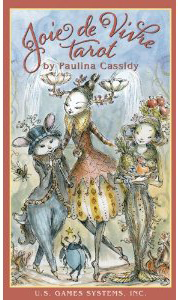
The Joie de Vivre Tarot by Paulina Cassidy and released by US Games is a very pretty deck. It’s a world of fantastical creatures in pastels and soft lines.
There are bunny-eared fairies, merlions, and well-dressed cats. Rabbits wear clothes, hats have faces, and seahorses can fly.
Joie de vivre, or the joy of living, is obvious in this deck. It’s happy and light, playful and friendly. But that doesn’t stop it from being serious as well.
For instance, its take on the Tower – a woman falling from a collapsing fortress of open-mouthed snakes, is hardly disregarding the impact Tower energy usually describes.
And the 3 of Swords clearly illustrates the pain of unreleased sadness. It’s just whispered, not shouted.
This isn’t a deck for those people most interested in traditional tarot symbology, or who want their cards to talk tough. But don’t be fooled into thinking the Joie de Vivre is just a frilly, fluff deck. I think it has real spirit.
It loosely follows the RWS structure and those readers familiar with that system should have no trouble understanding it. But Cassidy’s pictures are unique and create their own Tarot universe.
Each character has a name and their story is described in the booklet that comes with the deck. The names are derived from the energy of the card and can be used as key words.
Examples include Ponder for the Hanged Man and Orbit for the Wheel. The Devil’s called Deception, and Gleam, Glitter, and Glow are the ladies in the 3 of Cups.
It’s clear that the focus of the Joie de Vivre Tarot is finding joy, but I still went ahead and asked it my usual ‘new deck’ question – what do you like talking about most?
The card I got was the 10 of Swords, certainly not the most joy-filled card in the deck.
In fact, the veiled fairy in the picture looks sad, lonely and unconsoled by her snail and snake companions. There’s darkness in the background and the moon is shrouded in fog.
The booklet says the fairy’s name is Lament and that she’s at her lowest point. Her dreams feel like dust and all she has left is her will.
But the nine swords in the background are her worries, and they’re further away than she thinks. And on her lap is the sword of fortitude with which she’ll carve a new beginning.
This 10 of Swords is the perfect card to explain what the Joie de Vivre Tarot likes to talk about most. Finding joy in the very pits of despair.
When your name becomes Lament and even the light of the moon has been dimmed, this deck wants to talk. Like the tiny star shinning above the fairy’s head, the Joie de Vivre wants to be a source of light.
What a sweet message and sweet pack of cards. If you’re looking for a little light, try out this deck.
When I first saw it, I thought it was pretty with its bright colours and vibrant imagery, but I was so blown away by Carding’s Transparent Tarot and Transparent Oracle that I didn’t give the Sidhe their proper due.
I know better now though, and after spending some time with this deck, I’ve come to like it more and more. The readings I’ve done with it have been intense and honest, but still somehow playful and even sweet.
It’s a great deck, and I recommend it highly.
And apparently so does Neopagan Priestess whose wonderful video review is posted below. Take a look ….